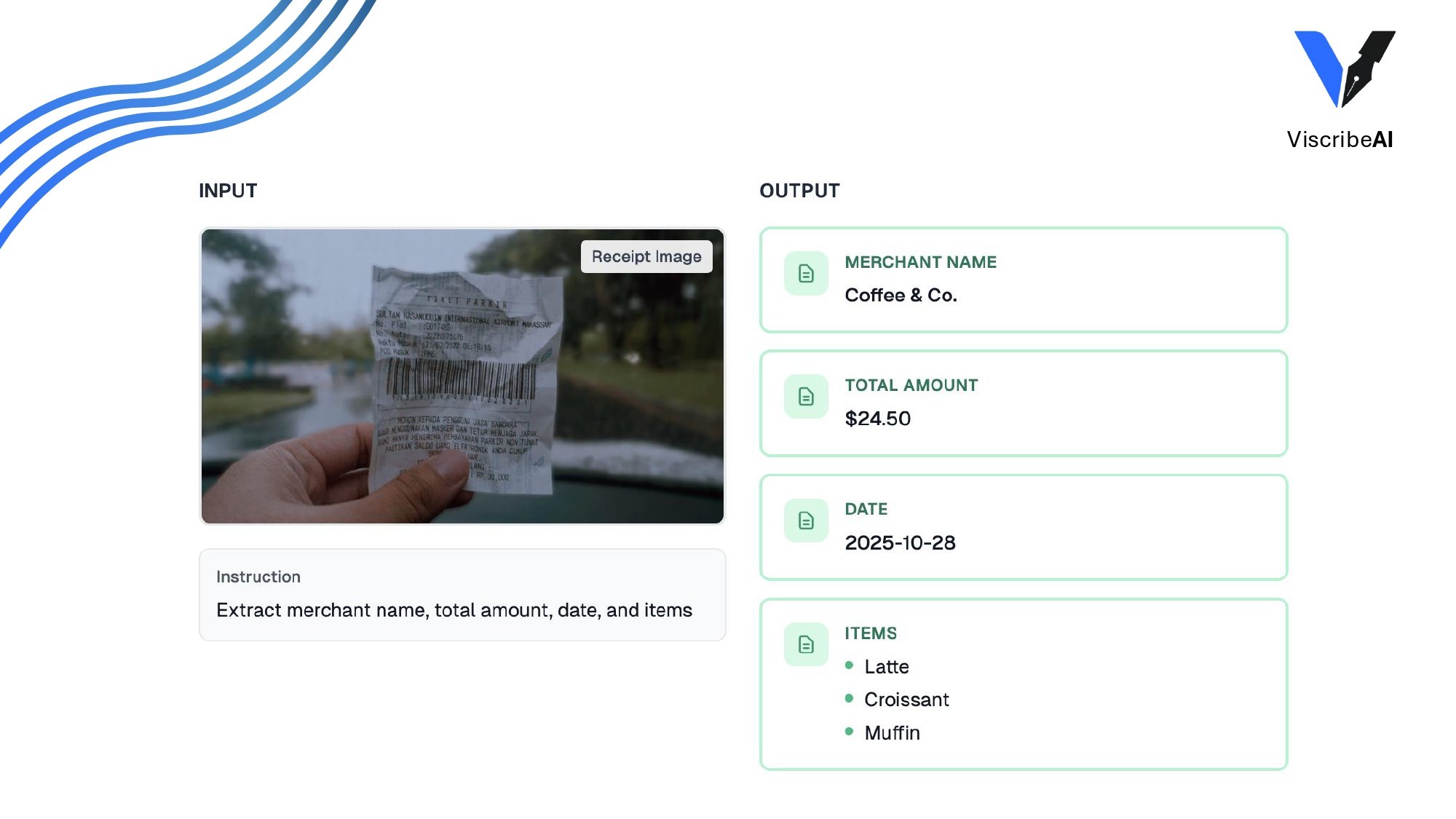
Extract feature example

Overview

extract turns an image into structured data. You provide an output_schema and an optional instruction, and ViscribeAI asks the model for strict JSON that matches that schema. Use simple fields for quick extraction. Use JSON Schema, or a Pydantic model in Python, when your application needs richer types or nested objects. In TypeScript, you can also pass a Zod schema directly.

Pydantic models

Python can accept a Pydantic model class as output_schema.
from pydantic import BaseModel, Field
from viscribe.images import extract


class Receipt(BaseModel):
    merchant_name: str | None = Field(description="Store or business name")
    total_amount: float | None = Field(description="Final total on the receipt")
    date: str | None = Field(description="Receipt date if visible")
    line_items: list[str] = Field(description="Visible purchased items")


result = extract(
    image_path="examples/receipt.png",
    output_schema=Receipt,
    instruction="Extract the receipt fields visible in the image.",
    model_config={"model": "gpt-5-mini"},
)

print(result.data.model_dump())

Simple fields

Simple fields support text, number, array_text, and array_number. ViscribeAI converts them into a strict object schema. A maximum of 10 fields is supported.
result = extract(
    image_path="examples/receipt.png",
    output_schema=[
        {"name": "merchant_name", "type": "text"},
        {"name": "total_amount", "type": "number"},
        {"name": "line_items", "type": "array_text"},
    ],
    instruction="Extract the receipt fields visible in the image.",
    model_config={"model": "gpt-5-mini"},
)

JSON Schema

Use JSON Schema when you need explicit schema control.
result = extract(
    image_path="examples/receipt.png",
    output_schema={
        "title": "Receipt",
        "type": "object",
        "properties": {
            "merchant_name": {"type": ["string", "null"]},
            "total_amount": {"type": ["number", "null"]},
            "line_items": {
                "type": "array",
                "items": {"type": "string"},
            },
        },
        "required": ["merchant_name", "total_amount", "line_items"],
        "additionalProperties": False,
    },
    model_config={"model": "gpt-5-mini"},
)

Zod schemas

TypeScript can accept Zod schemas as outputSchema. ViscribeAI converts the schema to JSON Schema for the model request, then validates the parsed response with Zod before returning result.data.
import { z } from "zod/v4";
import { images } from "viscribe";

const Receipt = z.object({
  merchant_name: z.string().nullish(),
  total_amount: z.number().nullish(),
  line_items: z.array(z.string()),
});

const result = await images.extract({
  imagePath: "examples/receipt.png",
  outputSchema: Receipt,
  instruction: "Extract the receipt fields visible in the image.",
  modelConfig: { model: "gpt-5-mini" },
});

console.log(result.data.total_amount);

Result and validation

result.data contains the parsed object. Python returns a Pydantic instance when the output schema is a Pydantic model; otherwise it returns a dictionary. TypeScript returns the parsed object, or Zod-parsed data when the output schema is a Zod schema. With strict mode enabled, ViscribeAI asks the provider for strict structured output and fills required properties for object schemas. Strict mode is enabled by default. Strict schemas are checked against the OpenAI Structured Outputs subset before the request is sent. Unsupported schemas raise StructuredOutputSchemaError with a schema path and suggested fix. ViscribeAI also validates parsed model output locally before returning result.data. Invalid output raises StructuredOutputValidationError.

Output Schema Validation

Learn how Python and TypeScript validate extracted data against your output schema.